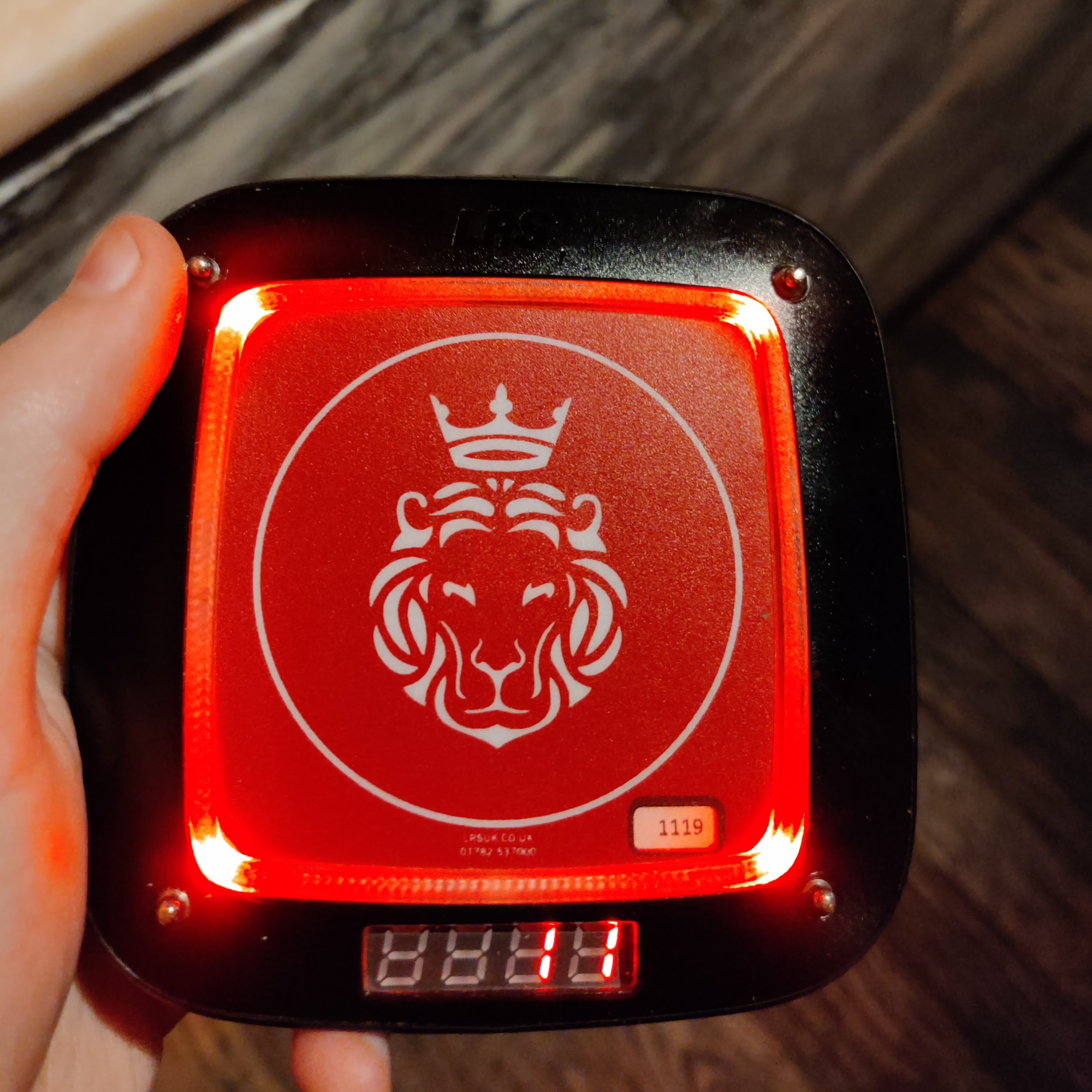
After our presentation last week, we decided that our next step was to come up with a place and purpose for replacing the sounds of communication with birdsong. We met for lunch at Mercato Metropolitano, where we immediately noticed the buzzers being used to let customers know when an order was ready, giving us an immediate idea for the next step of development.
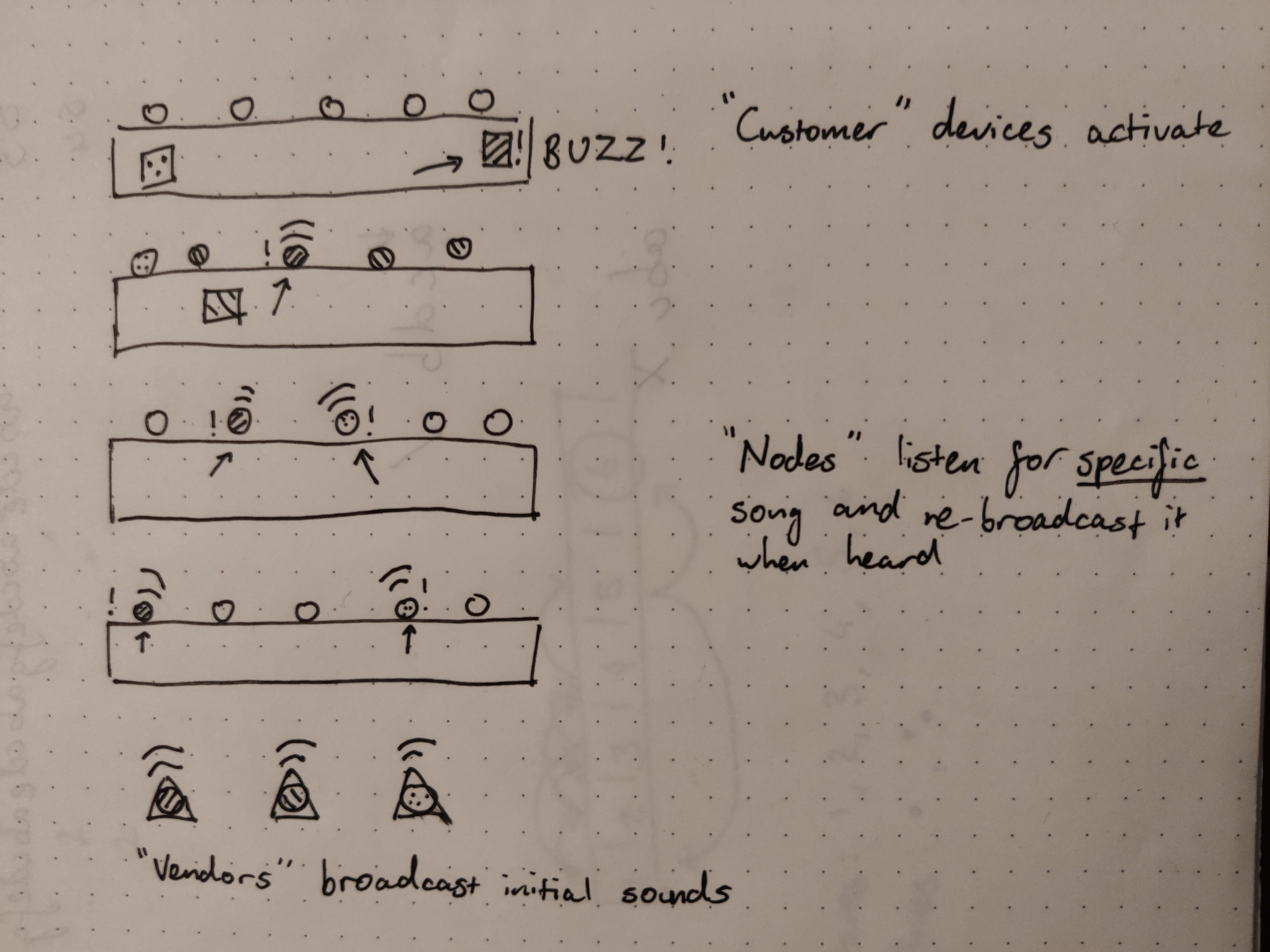
We created a quick sketch for how this might look within the space of the classroom, where we would be presenting come Thursday. The idea was that we created several network of “nodes” across the classroom that would listen for and rebroadcast specific bird calls. When a buzzer detected its assigned bird call, it would activate by lighting up and vibrating. This way, we could fill a large open space with birdsong, having the sound ripple throughout the room – in a tutorial, Tonicha used the metaphor of a “sound Mexican wave” which we particularly enjoyed.
However, upon visiting the Creative Technology Lab, we were told that we would struggle to build this in time for Thursday’s presentation, as we would need to rely on resources such as technicians and physical computing devices that were not available, so we decided to change approach. Additionally, we worried that the food buzzer idea was too tied to the function of the device rather than the experience, and so we decided to move to the simpler concept of an alarm, which we planned to use during the presentation to notify us of time remaining. In retrospect, as much of the class was not able to immediately grasp the purpose of our design, a more clear-cut and task-oriented goal should have been considered an advantage rather than a disadvantage.
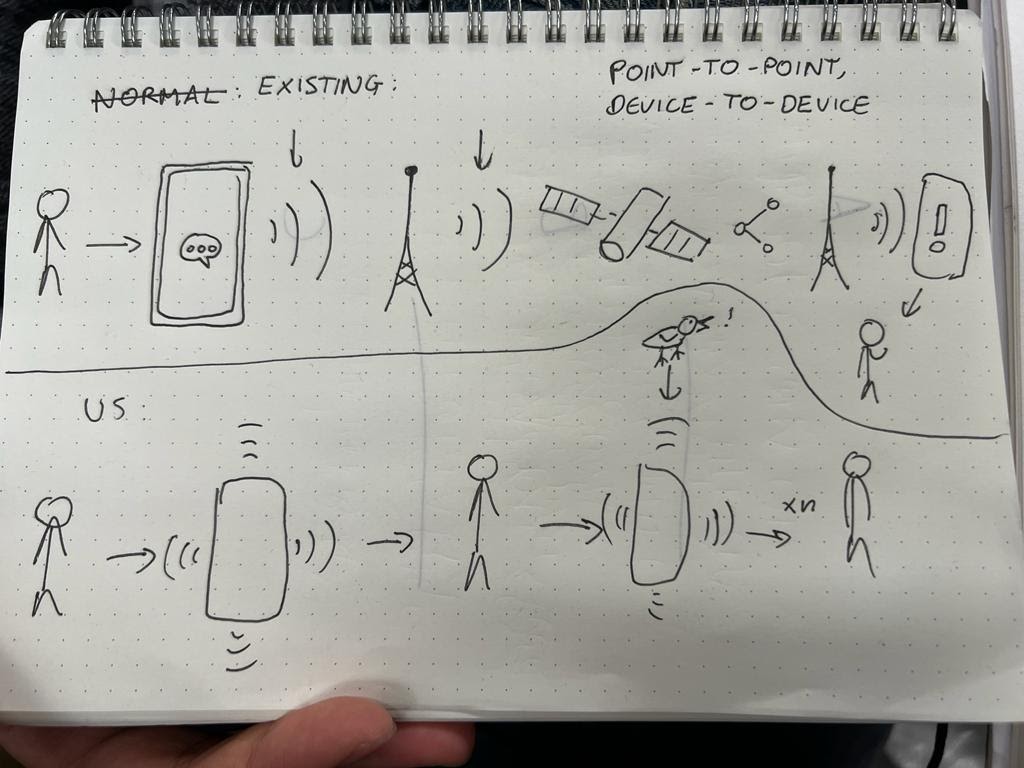
The above sketch shows our idea in relation to existing communication networks, with people and their devices replacing the complex network of infrastructure involved in point-to-point communication, and the sound of birdsong replacing EM radiation as a broadcasting “material”.
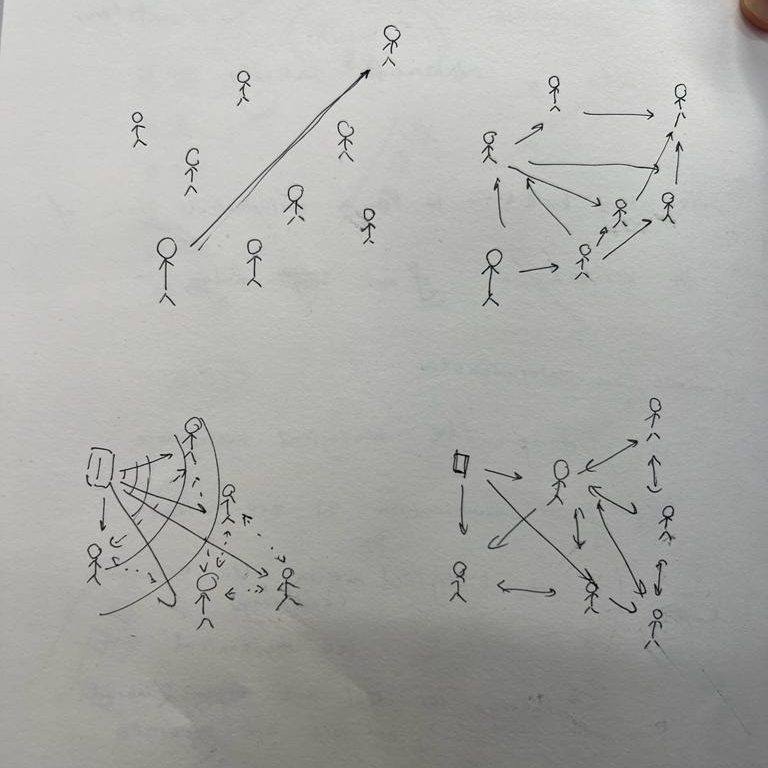
The top row of this diagram demonstrates our desire to move from a direct broadcast to one affecting all present individuals; the second row shows a desire to reduce the importance of a central broadcaster, reinforcing person-to-person links.
In the presentation, unfortunately, we did not communicate the actual function of our prototype successfully – people did not rebroadcast the sounds as they heard them, resulting in a (fairly devastating) silence throughout the room, and feedback that seemed to not understand the goals of our project, instead focusing on possible applications more akin to our designs from the previous week.
Looking back, I believe that if our prototype had worked, feedback would have been more relevant to the ideas we had in mind. We spent too much of our presentation time focused on explaining the theoretical basis of our work, and not enough explaining the experience, placing unfair expectations on our classmates as participants. Perhaps this could have been mitigated by earlier and more robust physical experimentation with our design.
 Harry Solomons