We began our research by undertaking artefact analysis, choosing a Tom Ford make up kit; our readings had taken us in a variety of different directions, from online avatars to social media interaction to physical appearance, and so we wanted to allow our next steps to be guided by the results of the analysis.


From our analysis, we drew out several themes we wanted to explore further:
- Make up, a form of social disguise, represents a huge industrial and capitalist system;
- Considering well-established links between identity and performance, such as in the work of Cindy Sherman and Judith Butler, it follows that altering more obvious performative traits can be a form of disguising identity;
- In terms of make up, individual components of disguise are often joined into a cohesive kit.
Keyi, at this stage, was keen to establish that she did not want to go down a route of disguising identity through fashion or appearance. Her undergraduate work had revolved around these aspects and she firmly believed that the social expectations surrounding appearance would muddle the points we were looking to make about disguise. While we had several debates around this point, and disagreed at some stages, I am glad that she insisted on defending her point here as our discussions uncovered several interesting areas to explore.
One such area was a focus on physical performance, rather than appearance. We uncovered several studies showing that gait recognition was becoming more commonly used in public surveillance (Wan, Wang and Phoha, 2018; Bashir, Xiang and Gong, 2010), and so we decided to focus on gait adjustment as a form of defeating surveillance.
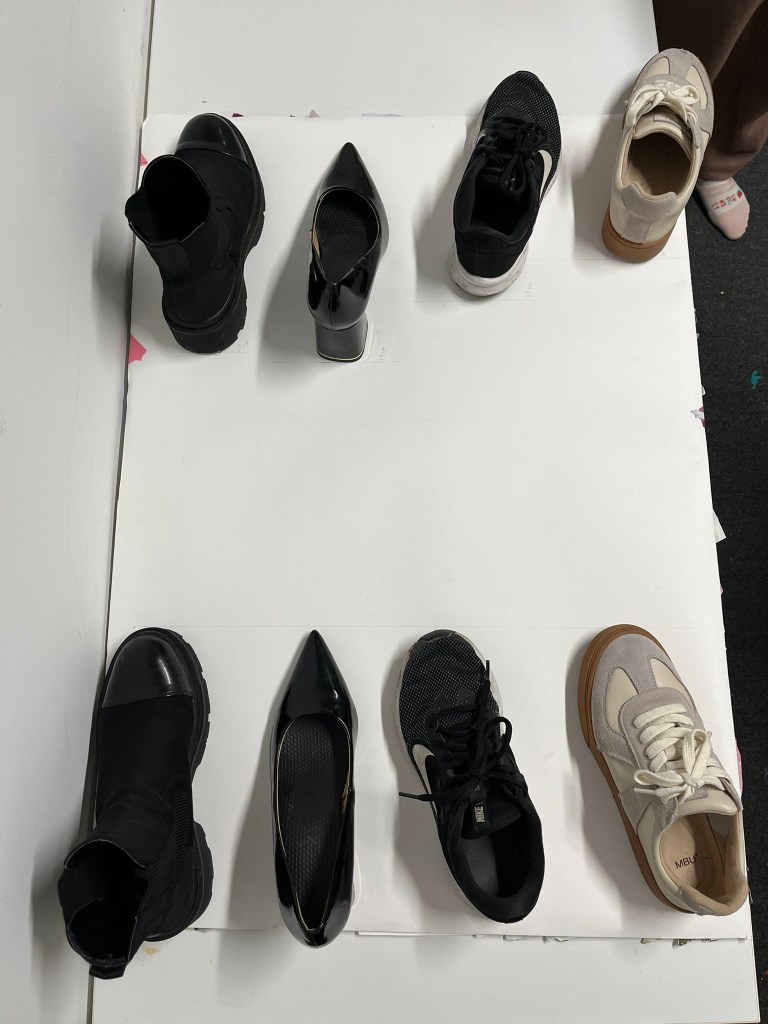
For our data physicalisation, we modeled the way in which Roshni’s feet landed and her stride length when she wore different types of shoes; we laid these out on a piece of plasterboard to demonstrate this. We found little significant difference in the footwear, so we switched focus to the rest of the body in addition.

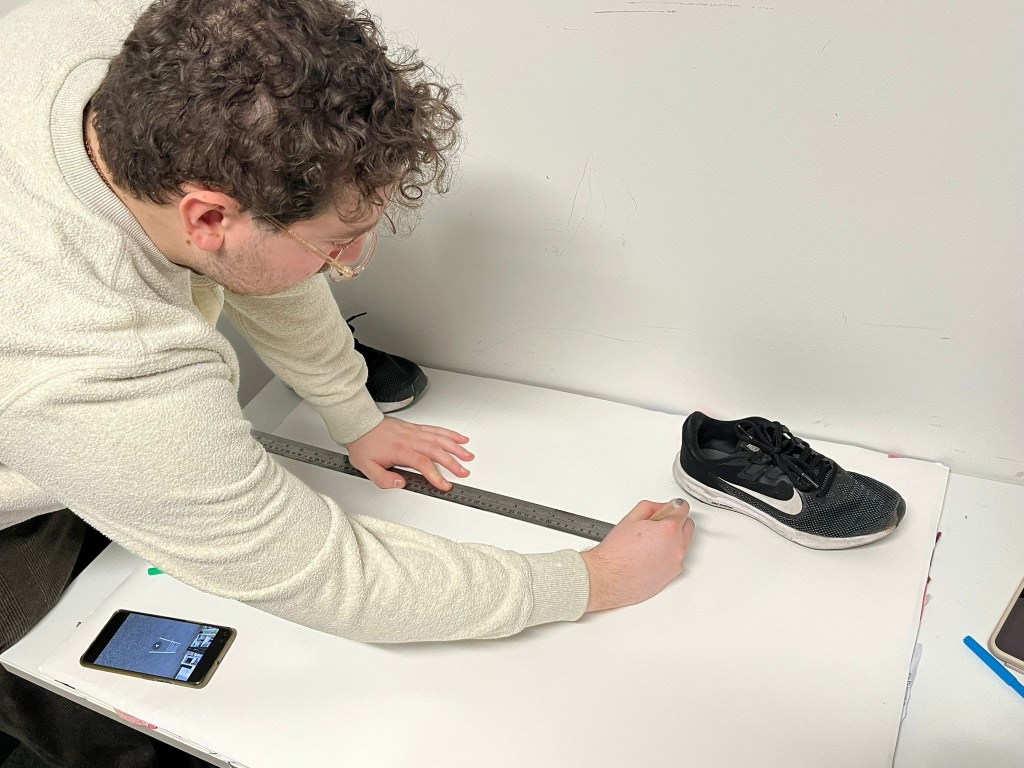
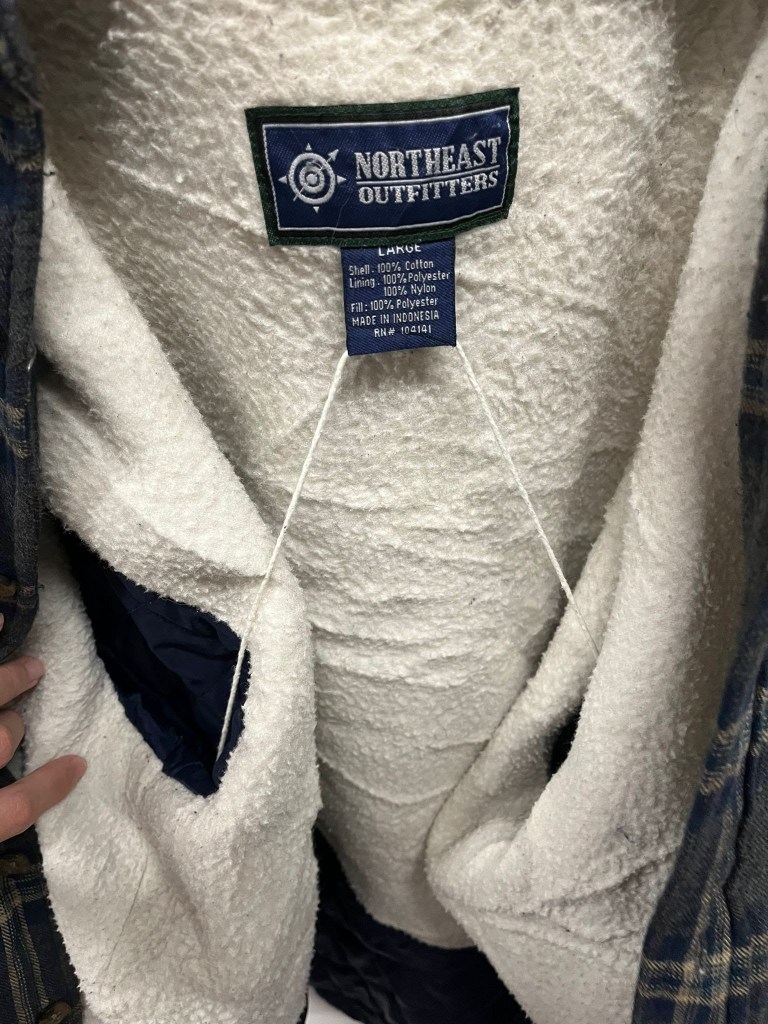
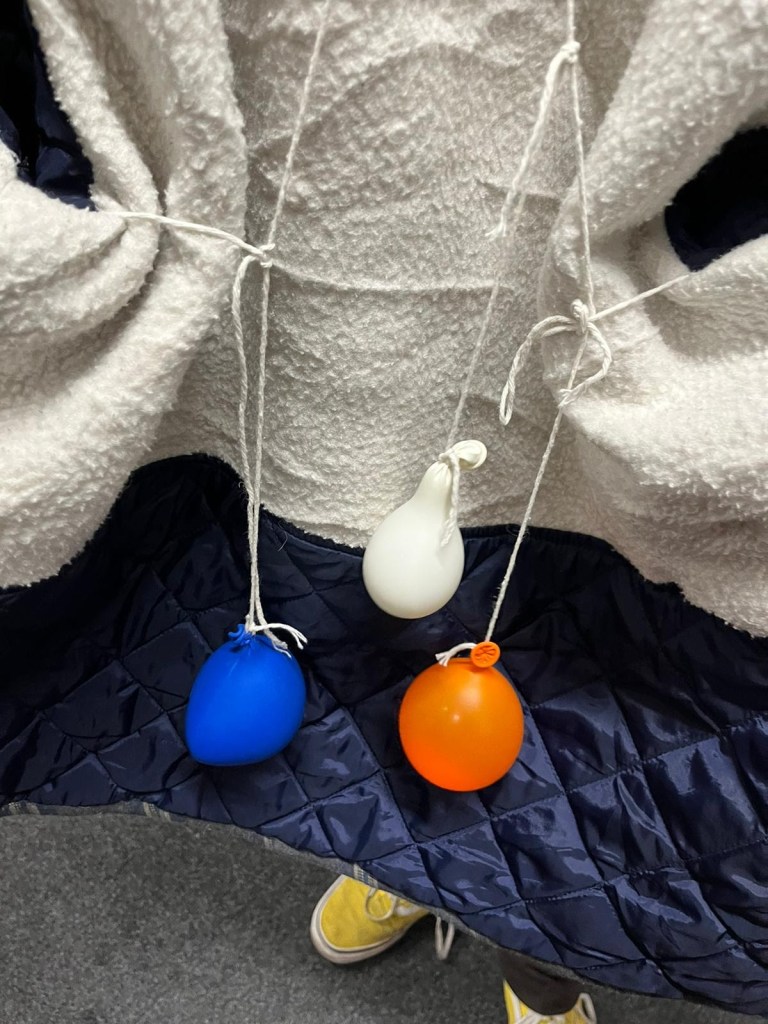
For our prototype, we placed a bottle cap in one shoe, and tied a piece of string across the shoulders of a jacket in order to pull in the wearer’s arms. Jakob was graceful enough to volunteer to try this on in class, and his posture noticeably shifted when wearing it.


We received the following feedback:
- We should allow the kit to be more customisable, so we were not reliant on a wearer’s shoe size;
- We should go further with our ambitions, changing posture more radically and perhaps forming a kind of performance;
- We needed to remain sensitive of conditions such as scoliosis that have significant effects on posture, making sure that it did not seem as though we were making light of or exploiting these conditions.
 Harry Solomons