Prior to next week’s midpoint presentation, this week involved running the workshops we had planned last week and analysing our results, in the hopes that we could move into ideas that could physically exist in the real world.
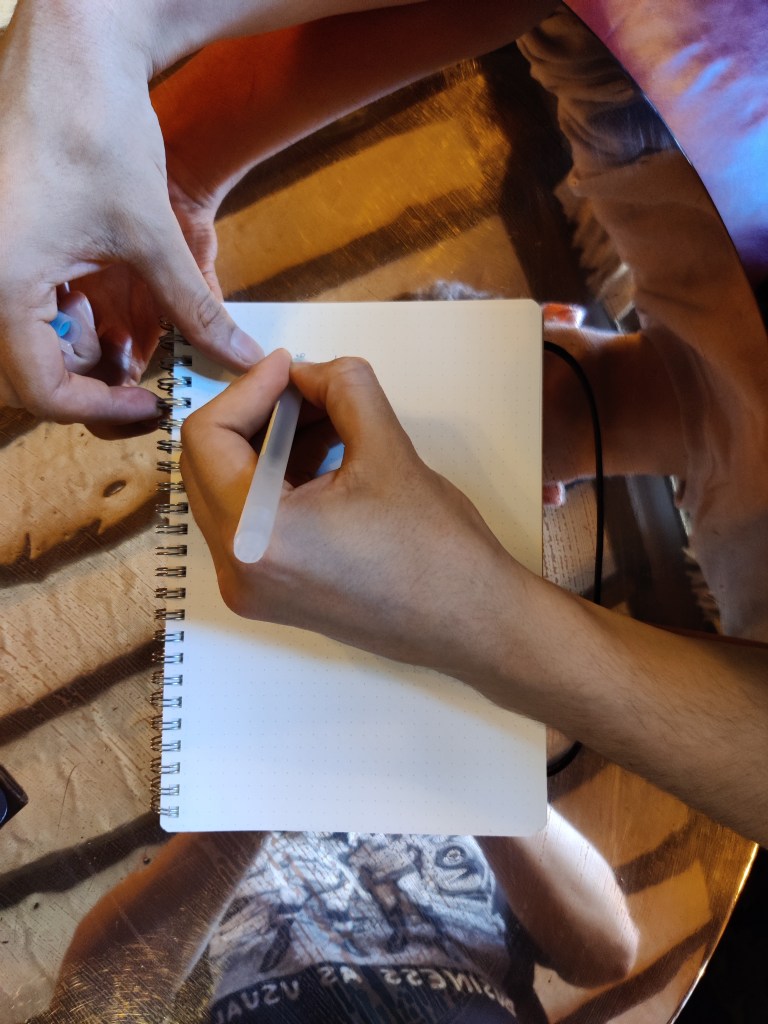

Me and Kim both ran the workshop a couple of times and tried to perform thematic analysis on our insights.
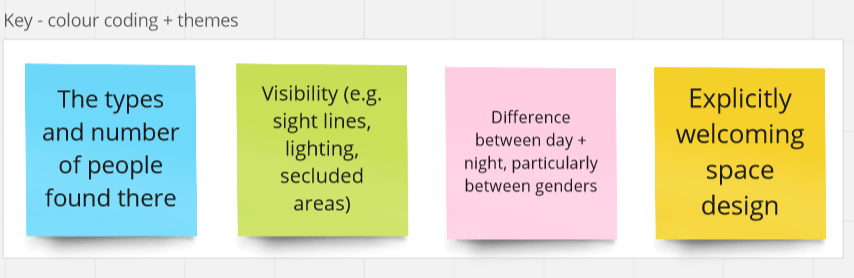
These were the insights that we felt were most relevant to our design going forward:
- Several women we interviewed mentioned being tired of talking about safety, and so were more keen to give us feedback when discussing things they wanted to do more of, rather than areas they avoided
- Parks were an area that came up a lot in discussion, either as particularly safe or unsafe areas depending on the participant, indicating their overall importance to our participants
- While traditional CPTED topics of sightlines and lighting emerged frequently, the differences between times of day was most pronounced in the women and non-binary people we interviewed as compared to men
- Areas thought of as particularly safe often featured explicitly welcoming features: footpaths, support posters, etc.
The other groups focused their workshops on accessibility (in which participants rebuilt an environment to better suit a plasticene alien) and representation (where participants were asked to either write a word they associated with femininity, or select a pre-written word to describe themselves).


While our workshop and the representation workshop dealt largely in abstract interpretations, the accessibility workshop gave much more useful, material outcomes for this point in the project. This was a very important insight for the roles workshops can play at various parts of the project – that more direct making-focused approaches pay more dividends at later points than abstract ideas do. I’m glad we have done as many workshops as we have done, but it is going to be painful to discard many of our ideas if we cannot find a way to fold them into our design.
 Harry Solomons