This blog post will be slightly longer, as it covers the 3 weeks of work me and Cristele have had between my returning from Paris and our arrival back at university.
This week which represented our first chance to get feedback on our work thus far. To prepare, we converted some of our initial sketches into slightly higher-fidelity prototypes that we could present in order to communicate our ideas more clearly. At this point, we had come up with the following outcome: a digitally-augmented compass for tourists that directs you between pre-selected points. At each point, scanning an object would play a voice recording of a long-term resident of the area, in which they share a story about the location.
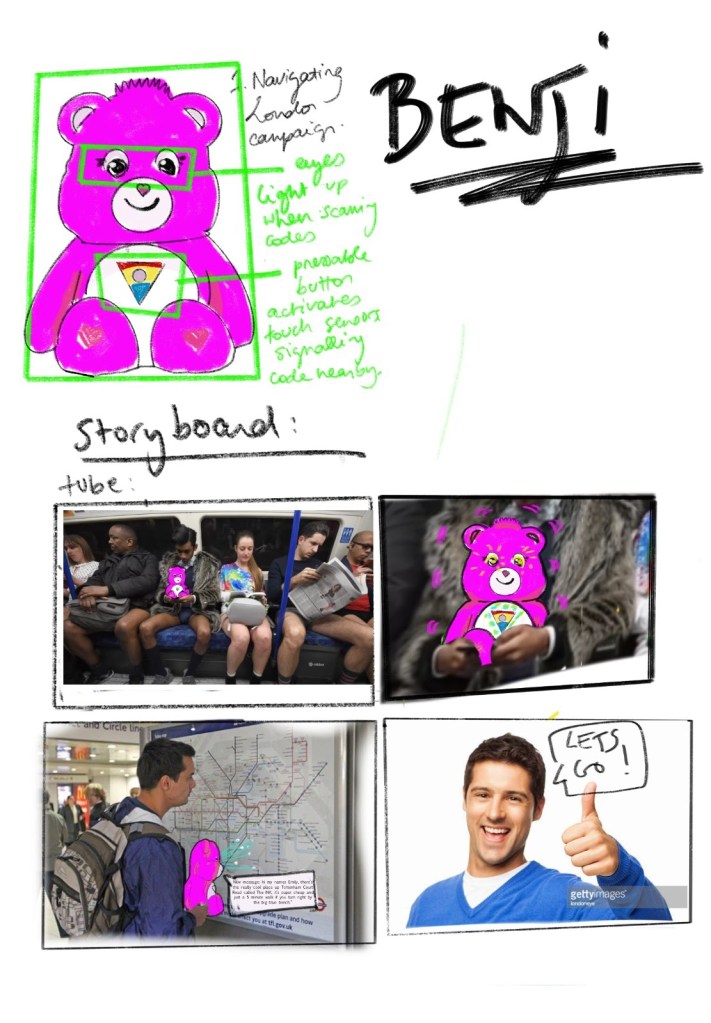

We chose this idea for a few reasons:
- Location-based wayfinding was more interesting to us than routes, as it allowed us an easier ‘in’ to begin discussing subjective local stories
- The compass appealed to us as it was a more explicit rejection of existing technologies
- Storytelling reflected a part of the experience that we wanted to draw out of participants – an acknowledgement of the subjectivity inherent in recreating spaces.
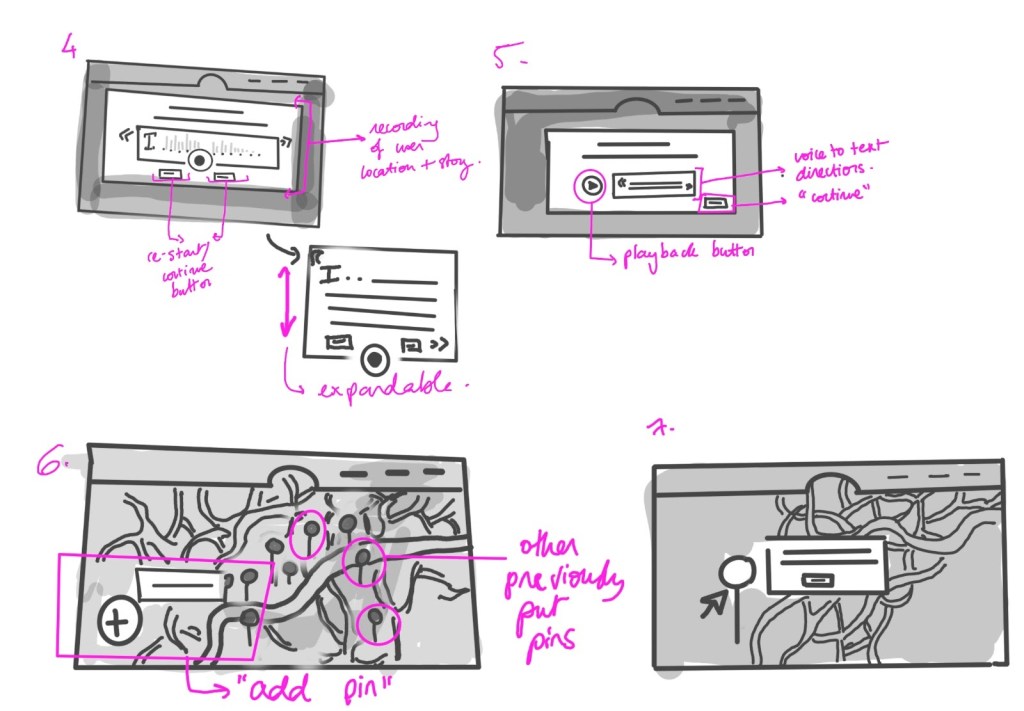
We also spent time developing very rough wireframes for a website/app that would allow people to upload their own stories. This is taken directly from our conversation with David Kopulos – we need to build in a point to step away from the product, and allow it to self-sustain.

Finally, we also prepared a potential timeline to completion of the project. An important detail is the inclusion of two full buffer weeks and the end of term, in which we can either work on our essay or finish uncompleted project work.
We received the following feedback when presenting:
- If we are presenting our work as a radical re-working of navigation post-GPS maps, then presenting an app or website strongly dilutes our message. This needs to be de-centred.
- The compass is a strong physical metaphor, and thus the physical side of our design is, at present, a stronger idea.
- We need to narrow our potential audiences: ‘tourists’ is a fairly nebulous (and difficult to contact) grouping.
- We need to ensure there is incentive for long-term residents to contribute to the project.
Reflections on Summer
This point marked a good stage to reflect upon our work over the Summer.
I believe me and Cristele work very strongly together as a team. We know each other well enough to be direct when addressing concerns about the work, and so it feels like a much more honest and open process than in some other project teams. This could be, in part, due to the size of the team; with 2 people, it is much easier to ensure that all input is heard and considered, and it has left us much more agile to change course and plans throughout the past few months.
I think we could have stood to perform slightly more primary research than we did. We spent a large portion of the break in different countries, and this directly hampered the amount of time we had to spend in person on gathering information. However, if we address this quickly in the upcoming weeks, we still have a good standing upon which to develop our ideas further.
This project also represents an interesting collision between our ideas of designing as an artistic endeavour vs designing for productisation and commercial goals. There are elements of our project, which we are trying to actively resist, that are capitalistically-oriented and beg questions of monetisation. Considering the audience and purpose for which we are developing this project, perhaps there is room to push our ideas further outside the realm of productisation.
 Harry Solomons