Based on last week’s work, we wanted to gain a better understanding of how urban storytelling could integrate with our project. To this end, we visited an exhibition at the Tower Hamlets Local History Library, called Everything is Different, Nothing has Changed, which heavily features archival oral histories from the area. The exhibition is of particular personal interest to me – my family were Jewish immigrants to Stepney in the early 20th century, and the lives of the East London Jewish community throughout the decades following are heavily represented in these works.
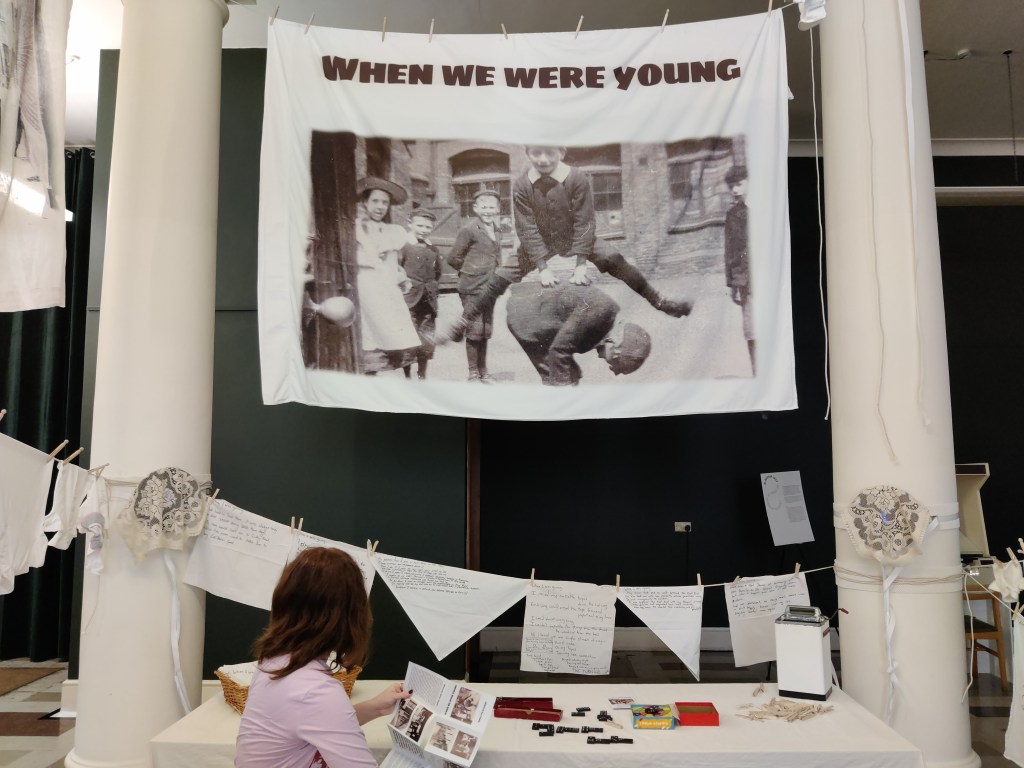

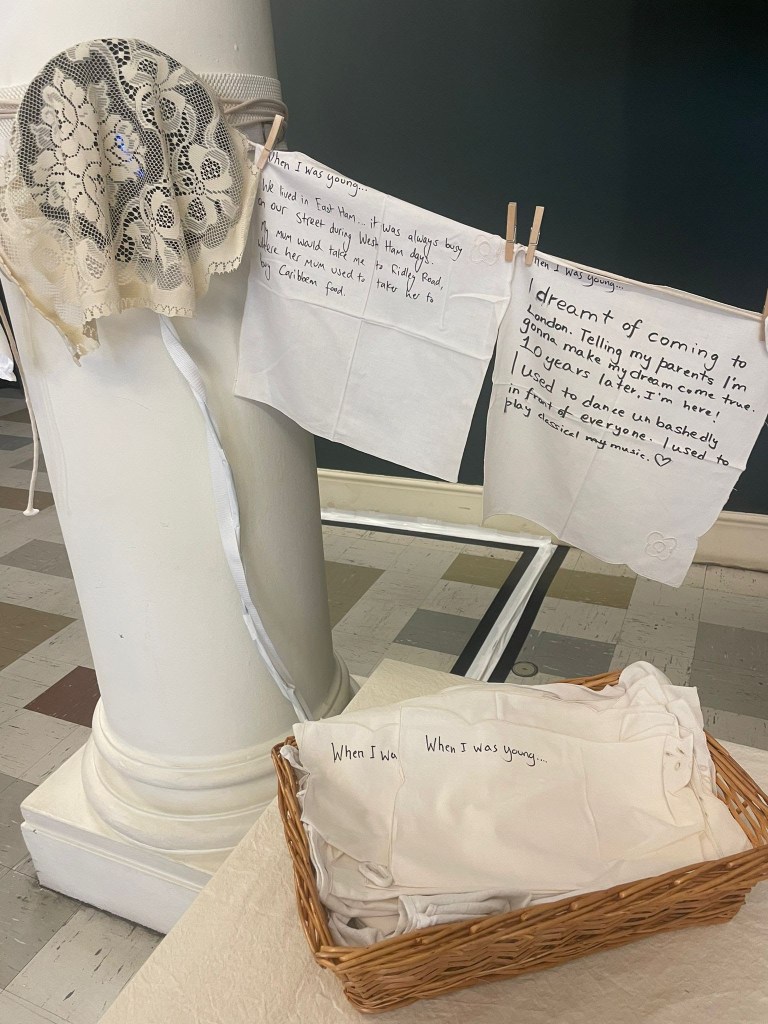
As pieces of sound art, each exhibit represented ways in which we could incorporate local histories into physical space. One example was Emily Peasgood’s When We Were Young, focusing on childhood stories, in which child actors re-recorded archival footage over sounds of children playing, and participants were invited to hang stories on a line like laundry. Another, by Alastair Levy, features stories playing over film photos of protests in Cable Street and Brick Lane.
We also spoke to staff working in the library about our project. They mentioned the importance of oral history to local archives, and expressed a strong willingness to work with us at the conclusion of our research. Importantly, they stressed that local residents would be very interested in taking part, as many feel it worthwhile to incorporate more permanently their own experiences in rapidly changing areas.
For our own project, we took the following to heart:
- Physical skeuomorphic design is a powerful and evocative tool in layering history onto present-day locations.
- Perhaps incentivising local residents to participate is unnecessary, following the advice of archive staff.
- Soundscapes are an additional evocative tool; if we can find a way to incorporate these using archival footage, our project will be even more powerful.
Directed Storytelling
We decided as a next step to narrow our user group. Briefly considering children as a core group (but dismissing this due to safeguarding concerns), we moved on to recent arrivals in the city, as the incoming cohort represented an eager group of participants and potential testers for our work. We conducted five directed storytelling sessions in which we invited participants to talk about their first week in London, particularly probing on how they gathered recommendations and sought local advice.
One interesting insight is how these people gained recommendations on what to do. We had assumed that maps software would be a common suggestion, but people placed a lot more emphasis on word of mouth and social media than anything else, in order to avoid busy or “touristy” locations.
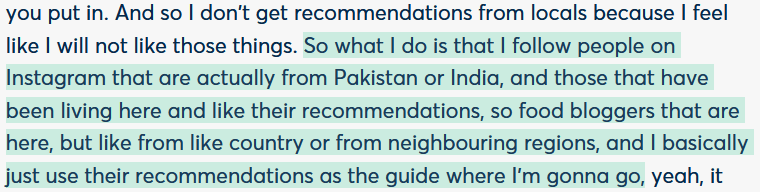

Additionally, we asked around the apps and tools that participants used to navigate. Google Maps, Apple Maps and Citymapper were all mentioned, particularly for public transport, but almost every participant mentioned a desire to explore on foot and “stumble across” interesting things


For our project, we took the following insights:
- This is positive confirmation that a desire exists to gather knowledge about the area for incoming residents, as well as the importance of exploring on foot.
- The existing tools that we are looking to counteract should include consideration of social media and travel bloggers, not just GPS map applications.
- When we discuss new residents, we should be explicit in avoiding extremely new residents – there is often a period of “settling in” before people are ready and willing to explore off the beaten track.
 Harry Solomons